
My role
When I worked as a UX Strategist at a large insurance company, I worked closely with deep domain experts. I used unique methods to gain their trust and get up to speed with the complex domains in question.
Sharing research results with Comics
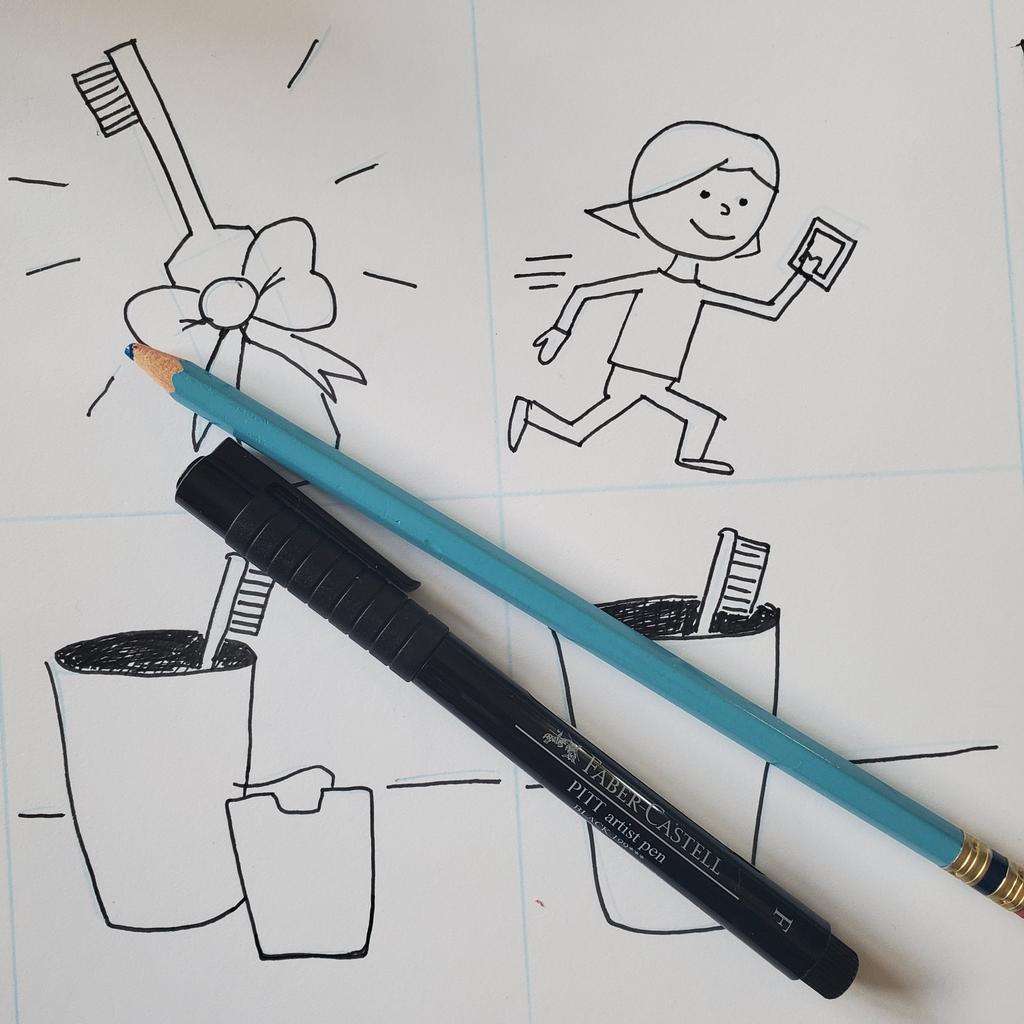
Yes, comics.
For a project, we had collected some great thick data through a series of problem interviews.
In some circumstances, a list of insights (with accompanying quotes) would be sufficient. In this case, I felt like I had to involve my stakeholders in the synthesis of the interviews for them to accept the results.
So… my colleague and I made comics. Each problem interview became a comic illustrating the story we heard. This helped address potential trust issues, because, by the very fact that we’re sharing each interview, we’re not glossing over inconvenient details.
When we presented our research, we got the tough questions that I expected about sampling and generalizability. We were ready for them. After we got past these questions, we talked about the stories.
I knew we had succeeded when the team barbed back and forth about details of the stories. ‘Could you believe x? Yeah, that was wild.”
Want to know more? I wrote about my comic making process on Medium. I’ve delivered workshops about my process at numerous venues – including the University of Waterloo, Wilfred Laurier University and Conestoga College.
Twenty Statements test
Twenty what?
While User Experience practitioners don’t talk about the Twenty Statements Test (TST) a lot, social psychologists have used it for almost 70 years. The TST was designed in 1954 by Manfred Kuhn and Thomas McPartland to identify and measure people’s self-concepts, i.e., the collection of beliefs people have about themselves.
The TST contains 20 “I am …” prompts. Test-takers are encouraged to complete as many prompts as possible in limited time.
I used a variation of the TST, first used by adult learning professionals. In 2015, Drs. Robin Grenier and Dana Dudzinska-Przesmitzki saw the potential of the TST to help experts externalize what they know. Instead of using “I am …” as the prompt, they substitute the name of the domain, such as “Safety is”, or even add a contextualized preference to the prompt, such as “I would go to a museum …”
I used the TST to learn from some especially busy domain experts. I was very concerned that the time we got with them would be well spent. I used the TST as a means to develop some foundational domain knowledge prior to our face time.
I got up to speed with the domain quickly. I prototyped an expert user interface based on what I learn.
I wrote about how I used the twenty statements test to gain domain knowledge on Medium.